Sigma Rules and Measures of Central Location
📹 Video Overview
🎯 What We're Learning Today
Main Topics:
-
Sigma Rules (∑) - Math shortcuts for summations
-
Measures of Central Location - Finding the "middle" or "typical" value
-
Mode (most common)
-
Mean (average)
-
Median (middle value)
-
Part 1: Sigma Rules (∑)
🔤 What is Sigma (∑)?
Sigma (∑) = Mathematical shorthand for "add everything up"
Example: Defective items in 10 shipments: 3, 4, 1, 5, 2, 3, 2, 6, 3, 1
Instead of writing: x₁ + x₂ + x₃ + x₄ + x₅ + x₆ + x₇ + x₈ + x₉ + x₁₀
We write:
💡 Memory hack: Think of ∑ as a "smart calculator" that knows to add everything from position 1 to n.
Breaking down the notation:
  n          ← Stop here (n = 10 in our example)
  ∑ x_i      ← Sum all x values
 i=1         ← Start here (first observation)
📐 The 5 Essential Sigma Rules
Rule 1: Sum of a Constant
Formula:
Plain English: If you add the same number n times, just multiply!
Example: Data series: 3, 3, 3, 3, 3 (n = 5)
💡 Memory hack: Adding 5 threes is just 5 × 3. Don't overthink it!
Rule 2: Sum of a Constant × Variable
Formula:
Plain English: You can "pull out" the constant from the sum!
Example: Defective items: 3, 4, 1, 5, 2, 3, 2, 6, 3, 1
If each defective item costs 5 NIS (a = 5), what's the total damage?
💡 Memory hack: The constant is like a "multiplier hat" - you can put it on at the end instead of on each item!
Rule 3: Sum of Addition
Formula:
Plain English: Sum of sums = sum of each separately!
Example:
| xᵢ | yᵢ | xᵢ + yᵢ |
|---|---|---|
| 1 | 3 | 4 |
| 2 | 4 | 6 |
| 3 | 6 | 9 |
OR:
💡 Memory hack: Addition is "friendly" - you can split it up!
Rule 4: Sum of Multiplication (TRICKY!)
Formula:
Plain English: You CANNOT split multiplication! Must multiply first, then sum.
Example:
| xᵢ | yᵢ | xᵢ × yᵢ |
|---|---|---|
| 1 | 3 | 3 |
| 2 | 4 | 8 |
| 3 | 6 | 18 |
CORRECT:
WRONG:
⚠️ CRITICAL: Multiplication is NOT friendly! Don't split it!
💡 Memory hack: "Multiply INSIDE the sum, not outside!"
Rule 5: Sum of Squares (ALSO TRICKY!)
Formula:
Plain English: Square each value first, THEN sum. Not the other way around!
Example:
| xᵢ | xᵢ² |
|---|---|
| 1 | 1 |
| 2 | 4 |
| 3 | 9 |
CORRECT:
WRONG:
⚠️ CRITICAL: Square INSIDE first, then add!
💡 Memory hack: "Square the individuals, not the team!"
📋 Sigma Rules Quick Reference
🧮 Practice Problem: Complete Walkthrough
Given:
| xᵢ | yᵢ |
|---|---|
| 1 | 3 |
| 2 | 4 |
| 3 | 6 |
Problem 1: Calculate
Solution:
Problem 2: Calculate
Solution:
First expand:
Calculate each part:
Final answer:
Part 2: Measures of Central Location
🎯 The Big Question
What's a "typical" or "representative" value in the data?
Example claim: "Economists earn more than teachers"
Does EVERY economist earn more than EVERY teacher? No!
So we need a way to describe the "center" of the data.
Three main measures:
📊 Measure 1: Mode (x̂)
Definition: The value (or category) that appears MOST frequently
Notation: x̂ (x-hat)
For Qualitative Variables:
Example: Preferred social network
| Social Network | f(x) |
|---|---|
| 43 | |
| 16 | |
| 4 | |
| TikTok | 2 |
| 1 | |
| None | 7 |
Mode = Instagram (highest frequency)
💡 Memory hack: Mode = Most popular = Most Often Displayed Everywhere
For Discrete Quantitative Variables:
Example: Number of people in family
| People (x) | f(x) |
|---|---|
| 2 | 3 |
| 3 | 2 |
| 4 | 1 |
| 5 | 3 |
| 6 | 1 |
Mode = 2 and 5 (both appear 3 times - bimodal!)
For Continuous Quantitative Variables:
Example: Test scores
| Scores | f(x) | l | d |
|---|---|---|---|
| 40-60 | 5 | 20 | 0.25 |
| 60-70 | 5 | 10 | 0.5 |
| 70-75 | 10 | 5 | 2 |
| 75-85 | 10 | 10 | 1 |
| 85-100 | 15 | 15 | 1 |
Mode = 72.5 (middle of class 70-75, which has highest density d = 2)
⚠️ Important: For continuous variables, use DENSITY (d), not frequency!
💡 Memory hack: The modal class is the "densest crowd"
🔍 Characteristics of Mode:
✓ Not affected by extreme values
✓ Not affected by other frequencies (only cares about the winner)
✗ Can have multiple modes (bimodal, multimodal)
✗ Might not represent the "center" well
📊 Measure 2: Mean (x̄)
Definition: The arithmetic average - sum all values and divide by count
Notation: x̄ (x-bar)
Basic Formula:
Example: Number of people in family: 2, 2, 6, 5, 3, 5, 5, 4, 3, 2
💡 Memory hack: Mean = What everyone would get if we distributed equally
Mean from Frequency Table:
Formula:
Why? If 2 appears 3 times, instead of writing 2+2+2, write 2×3!
Example:
| x | f(x) | p(x) | x × f(x) | x × p(x) |
|---|---|---|---|---|
| 2 | 3 | 30% | 6 | 0.6 |
| 3 | 2 | 20% | 6 | 0.6 |
| 4 | 1 | 10% | 4 | 0.4 |
| 5 | 3 | 30% | 15 | 1.5 |
| 6 | 1 | 10% | 6 | 0.6 |
| Total | 10 | 100% | 37 | 3.7 |
Using frequencies:
Using relative frequencies:
💡 Memory hack: "Multiply before you divide" - weight each value by how often it appears!
Mean for Continuous Variables:
Use the MIDPOINT of each class!
Example: Test scores
| Scores | f(x) | Midpoint (xᵢ) | xᵢ × f(x) |
|---|---|---|---|
| 40-60 | 5 | 50 | 250 |
| 60-70 | 5 | 65 | 325 |
| 70-75 | 10 | 72.5 | 725 |
| 75-85 | 10 | 80 | 800 |
| 85-100 | 10 | 92.5 | 925 |
| Total | 40 | - | 3025 |
How to find midpoint:
Example: For 40-60 → Midpoint = (40+60)/2 = 50
🔍 Characteristics of Mean:
✓ Uses all data - every value matters
✓ Most common measure - used everywhere
✗ Affected by extreme values (outliers can pull it way off!)
✗ May not be an actual data value (can't have 3.7 people!)
Special Property: Sum of deviations from mean = 0
Example: Data: 2, 2, 6, 5, 3, 5, 5, 4, 3, 2 (x̄ = 3.7)
| xᵢ | xᵢ - x̄ |
|---|---|
| 2 | -1.7 |
| 2 | -1.7 |
| 6 | +2.3 |
| 5 | +1.3 |
| 3 | -0.7 |
| 5 | +1.3 |
| 5 | +1.3 |
| 4 | +0.3 |
| 3 | -0.7 |
| 2 | -1.7 |
Sum = 0 ✓
💡 Memory hack: The mean is like a "balance point" - negatives and positives cancel out!
📊 Measure 3: Median (x̃)
Definition: The middle value when data is sorted - splits data 50-50
Notation: x̃ (x-tilde)
How to Find Median:
Step 1: Sort data from smallest to largest
Step 2: Find the middle position
If n is ODD:
Formula:
Example: Scores: 50, 60, 60, 70, 80 (n = 5)
Position of median = (5+1)/2 = 3rd value
Median = 60
If n is EVEN:
Formula:
Example: Scores: 50, 60, 60, 70, 80, 90 (n = 6)
Positions: 6/2 = 3rd and 4th values
Median = (60 + 70)/2 = 65
💡 Memory hack:
-
Odd: One clear middle person
-
Even: Two middle people, average them!
Median from Frequency Table:
Example: Number of people in family (n = 20)
| x | f(x) | F(x) |
|---|---|---|
| 2 | 3 | 3 |
| 3 | 5 | 8 |
| 4 | 6 | 14 |
| 5 | 3 | 17 |
| 6 | 3 | 20 |
Find: Position n/2 = 20/2 = 10th value
Look at F(x):
-
F(4) = 14 (14 observations up to x=4)
-
F(3) = 8 (8 observations up to x=3)
The 10th value is in the x=4 category!
Median = (x₁₀ + x₁₁)/2 = (4 + 4)/2 = 4
Median for Continuous Variables:
Find the "median class" - the class containing position n/2
Example: Test scores (n = 100)
| Scores | f(x) | F(x) |
|---|---|---|
| 40-60 | 5 | 5 |
| 60-70 | 10 | 15 |
| 70-75 | 20 | 35 |
| 75-85 | 40 | 75 |
| 85-100 | 25 | 100 |
Position n/2 = 100/2 = 50th value
-
F(70-75) = 35 (not enough)
-
F(75-85) = 75 (includes position 50!)
Median is in class 75-85
💡 Memory hack: Keep adding F(x) until you pass n/2!
🔍 Characteristics of Median:
✓ Not affected by extreme values (only cares about position, not actual values!)
✓ Always an actual possible value (for discrete) or in a real class
✗ Doesn't use information from all values
Powerful example:
Salaries: 3000, 4000, 4700, 5000, 5500
Median = 4700 (middle value)
Now change 5500 to 5,500,000!
Median still = 4700 (position unchanged!)
Mean would jump dramatically!
💡 Memory hack: Median is the "bodyguard" - protects against extreme outliers!
🔄 Linear Transformations
What if we add/multiply all values by a constant?
Rules:
If (where a and b are constants):
Example: Test scores of 7 students: 91, 77, 65, 83, 88, 71, 98
Teacher adds 2 points to everyone:
New mean:
💡 Memory hack: "What you do to the data, you do to the measures!"
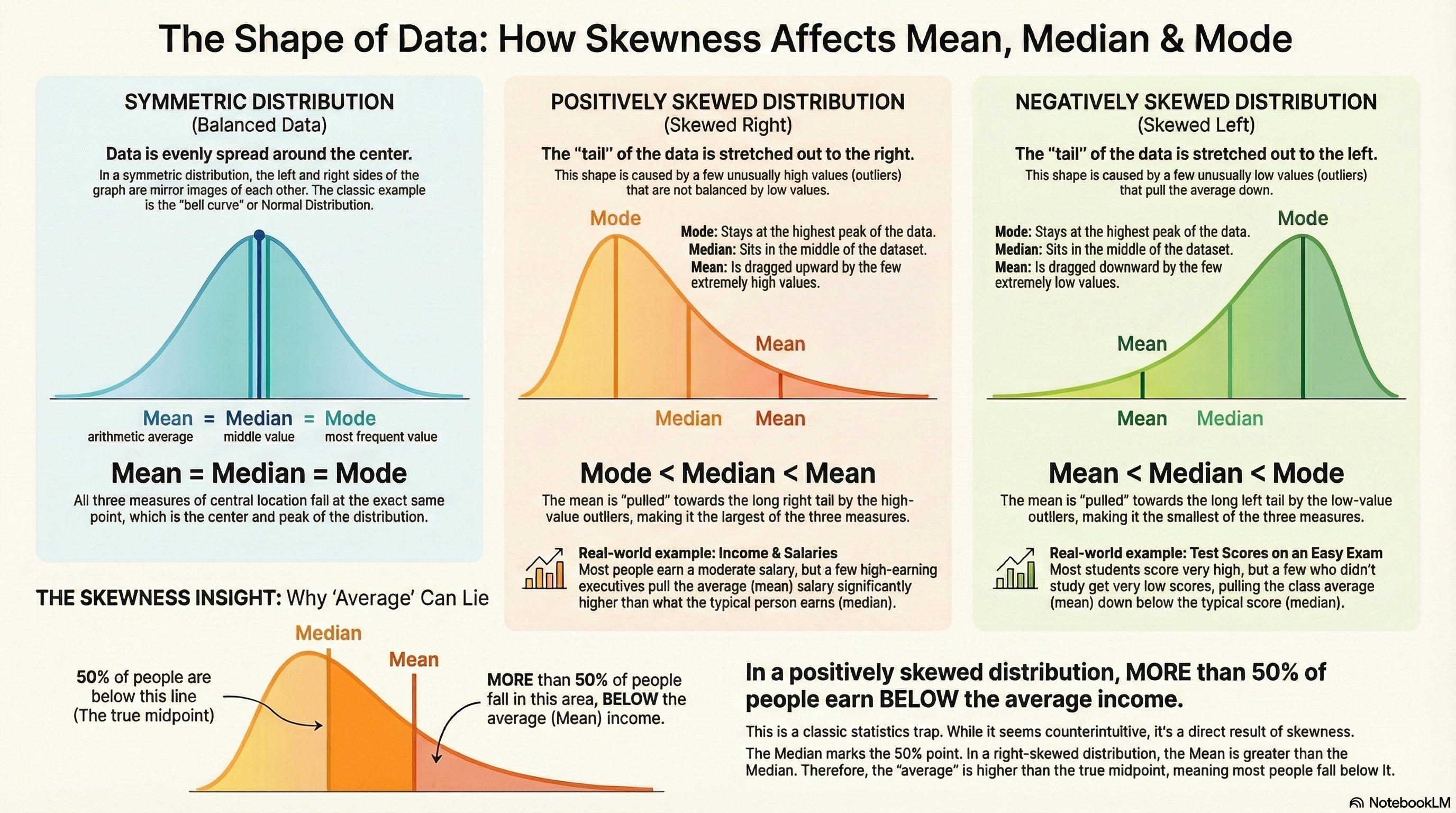
📈 Distribution Shapes & Central Measures
Symmetric Bell-Shaped (Normal Distribution):
        📊
      📊📊📊
    📊📊📊📊📊
  📊📊📊📊📊📊📊

Mode = Median = Mean
All three are equal!
Symmetric (Two Peaks):
  📊      📊
📊📊    📊📊
📊📊📊📊📊📊

Mode < Median = Mean
Two modes, median and mean still equal
Uniform Distribution:
📊📊📊📊📊📊📊

No clear mode
Median = Mean
Positive Skew (Right Tail):
📊📊📊
📊📊📊📊
📊📊📊📊📊📊  →

Mode < Median < Mean
Mean pulled by high values!
💡 Memory hack: "Mean follows the tail" - gets pulled toward outliers
Example: Salaries - few very high earners pull mean up
Negative Skew (Left Tail):
        📊📊📊
      📊📊📊📊
← 📊📊📊📊📊📊

Mean < Median < Mode
Mean pulled by low values!
📋 Decision Guide: Which Measure to Use?
| Situation | Best Measure | Why |
|---|---|---|
| Symmetric data, no outliers | Mean | Uses all info, most precise |
| Skewed data | Median | Not affected by extreme values |
| Categorical data | Mode | Only option! |
| Need "most typical" | Mode | Most common actual value |
| Extreme outliers present | Median | Robust against extremes |
🎯 Test Question Practice
Question: "University graduate salaries are positively skewed. Therefore, the percentage earning above average is greater than the percentage earning below average."
True or False?
Answer: FALSE!
Explanation:
-
Positively skewed → tail on right (high salaries)
-
Mean gets pulled UP by extreme high salaries
-
Mean > Median
-
Since median splits data 50-50:
-
50% earn below median
-
50% earn above median
-
-
Since mean > median:
-
MORE than 50% earn below mean
-
LESS than 50% earn above mean
-
💡 Memory hack: In positive skew, the mean "chases" the few rich people, leaving most below average!
📊 Advanced Concepts
Skewness
Measures asymmetry of distribution:
Rule of thumb:
-
Between -0.5 and 0.5 → Approximately symmetric
-
Between 0.5 and 1 (or -0.5 and -1) → Moderately skewed
-
Beyond ±1 → Highly skewed
Kurtosis
Measures "peakedness" of distribution:
-
Mesokurtic (Kurt = 3): Normal distribution
-
Leptokurtic (Kurt > 3): Tall and thin peak, heavy tails
-
Platykurtic (Kurt < 3): Flat peak, light tails
🎓 Key Formulas Summary
| Measure | Formula | Use When |
|---|---|---|
| Mode | Value with highest f(x) or d | Any variable type |
| Mean (raw) | Individual data | |
| Mean (frequency) | Frequency table | |
| Mean (relative) | Relative frequency | |
| Median (odd n) | Sorted odd data | |
| Median (even n) | Sorted even data | |
| Linear transform | When transforming all data |
💡 Master Memory Hacks
-
Sigma ∑ = Smart calculator that adds for you
-
Mode = Most Often Displayed Everywhere
-
Mean = Everyone gets equal share
-
Median = The middleman/bodyguard (protects from extremes)
-
Multiplication & Squares = Cannot split the sum!
-
Mean follows the tail in skewed distributions
-
Midpoint = Average of class limits
-
F(x) = Climbing stairs - keep adding
🎯 Quick Reference Mind Map
⚠️ Common Exam Mistakes
❌ Splitting multiplication/squares in sigma sums
❌ Using frequency instead of density for continuous mode
❌ Forgetting to sort data before finding median
❌ Confusing "at least" with "at most"
❌ Thinking positive skew means more above average
❌ Using mean when there are extreme outliers
🏆 Pro Exam Tips
-
See ∑? Check if you can pull constants out!
-
Finding mode in continuous? Look for highest DENSITY (d), not frequency!
-
Extreme values present? Use median, not mean
-
Positive skew? Mean > Median > Mode (remember: mean follows tail)
-
Linear transformation? Apply it to the measures directly
-
Frequency table? Use weighted formula (x × f)
Remember: The distribution shape tells you the relationship between mode, median, and mean!